Using the Cash or Points Calculator
The Cash or Points Calculator lives on every program page that has a known valuation. It answers a simple question: for this specific booking, is it cheaper to pay cash or use points?
The Basics
Section titled “The Basics”The calculator needs just two numbers to give you an answer:
- Cash price — What you’d pay if you booked with cash (the fully loaded price including all taxes)
- Award cost — The number of points the program charges for the award booking
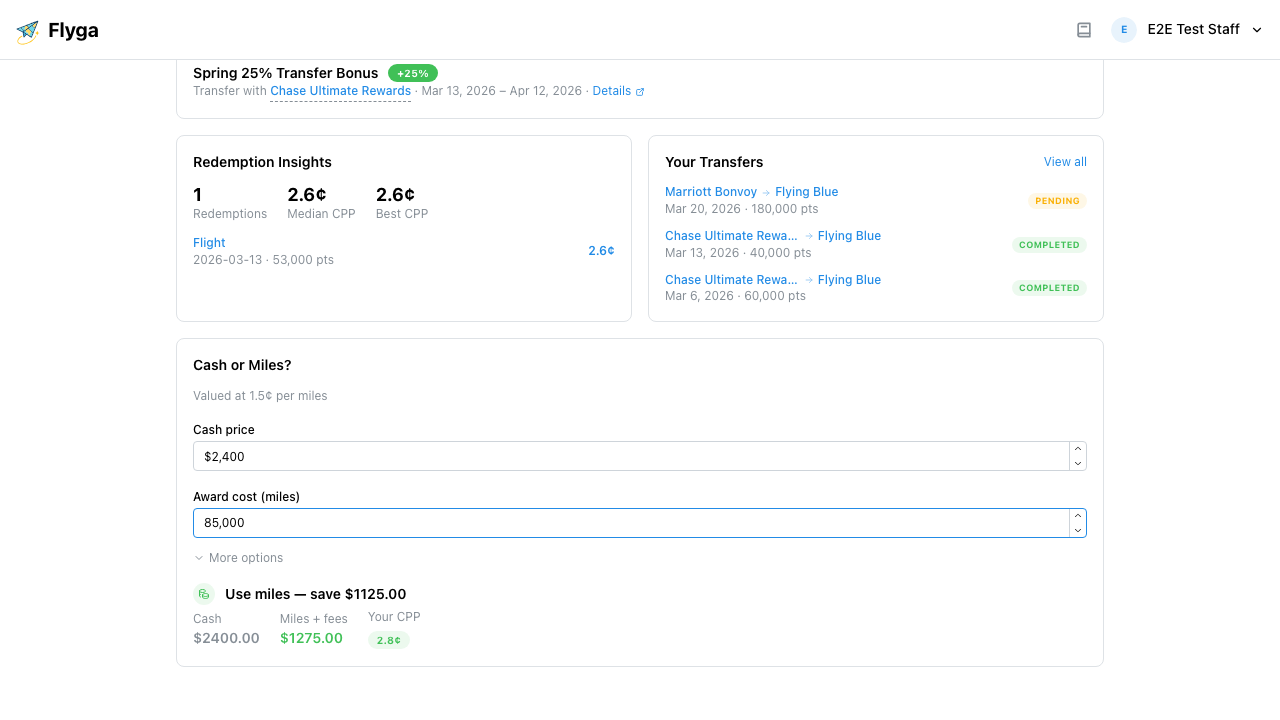
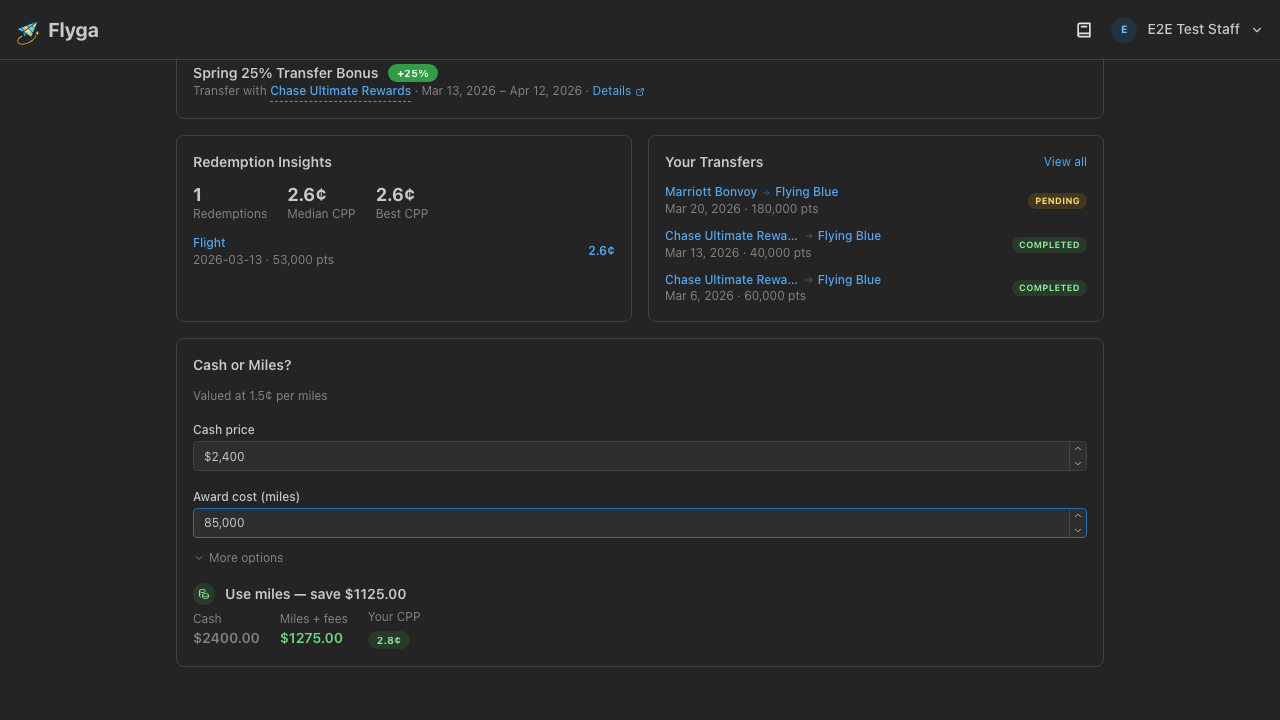
As soon as both are filled in, Flyga shows you whether cash or points is the better deal, how much you save, and your actual cents-per-point for this redemption.
Reading the Results
Section titled “Reading the Results”The results section shows three things:
- Verdict — A clear recommendation: “Use points — save $X” or “Use cash — save $X”
- Side-by-side cost — The cash price next to the points-plus-fees cost in dollars, with the cheaper option highlighted in green
- Your CPP — The actual cents-per-point you’d get from this redemption. A green badge means you’re getting above-average value (higher than the program’s baseline valuation). An orange badge means below average.
More Options
Section titled “More Options”Click More options to reveal two additional fields:
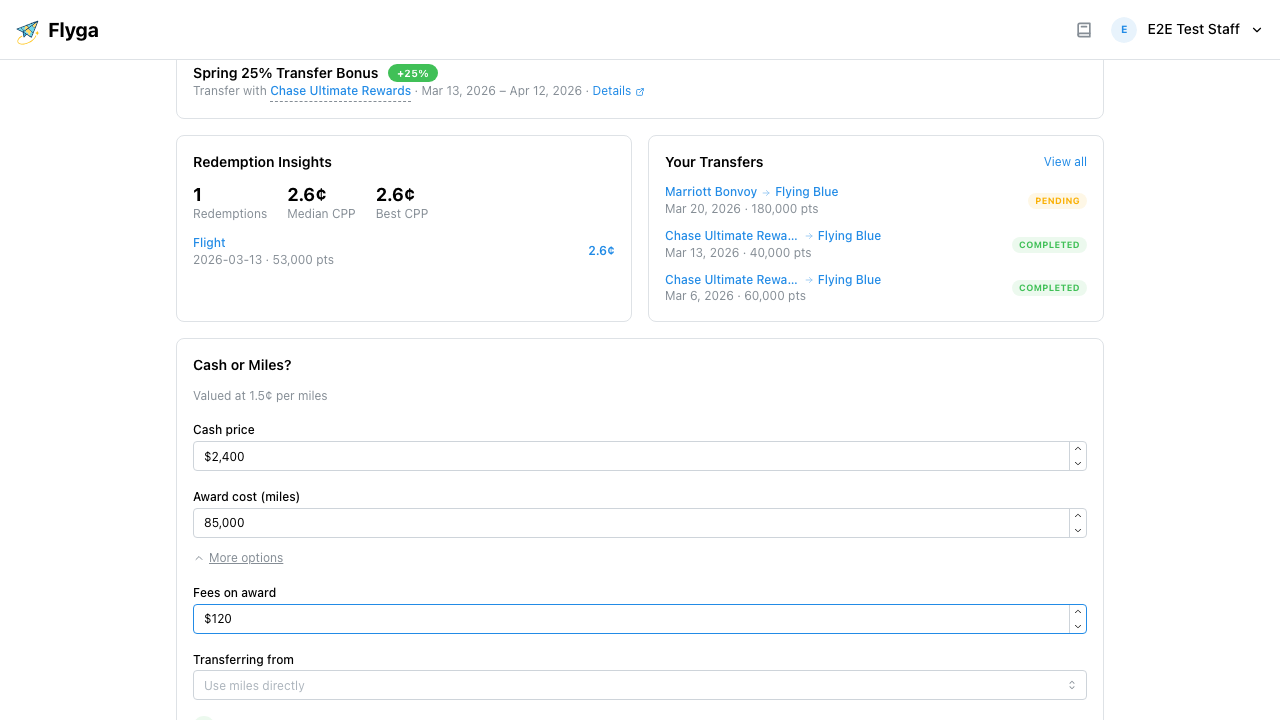
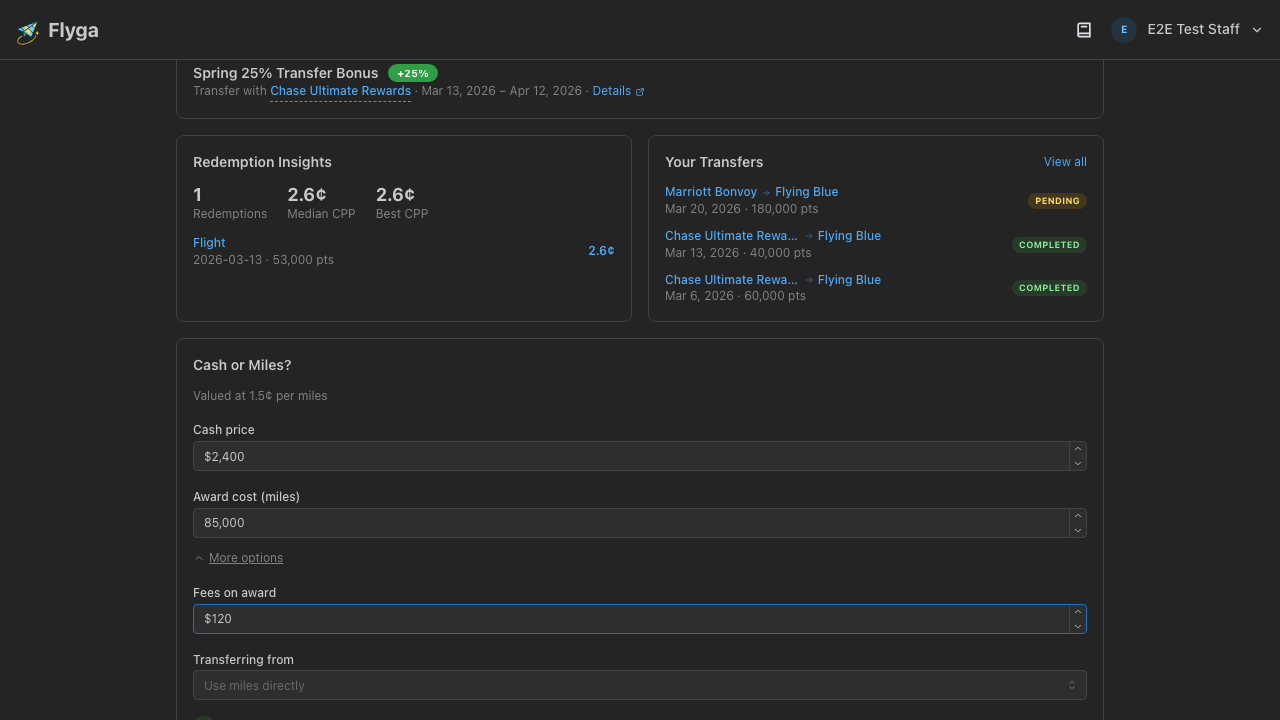
Fees on Award
Section titled “Fees on Award”Most award bookings come with taxes, fuel surcharges, or other fees you pay in cash on top of the points. Enter those here. The calculator subtracts fees from the cash price when computing your CPP, giving you a more accurate comparison.
Transferring From
Section titled “Transferring From”If you don’t hold points in this program directly but could transfer from a credit card program, select the source program here. The calculator adjusts the math based on:
- The source program’s valuation — Chase Ultimate Rewards at 1.8 cents per point are “more expensive” to spend than a program valued at 1.2 cents
- The transfer ratio — A 1:1 ratio means one source point becomes one destination point. A 2:1 ratio means you need two source points for each destination point, doubling the effective cost
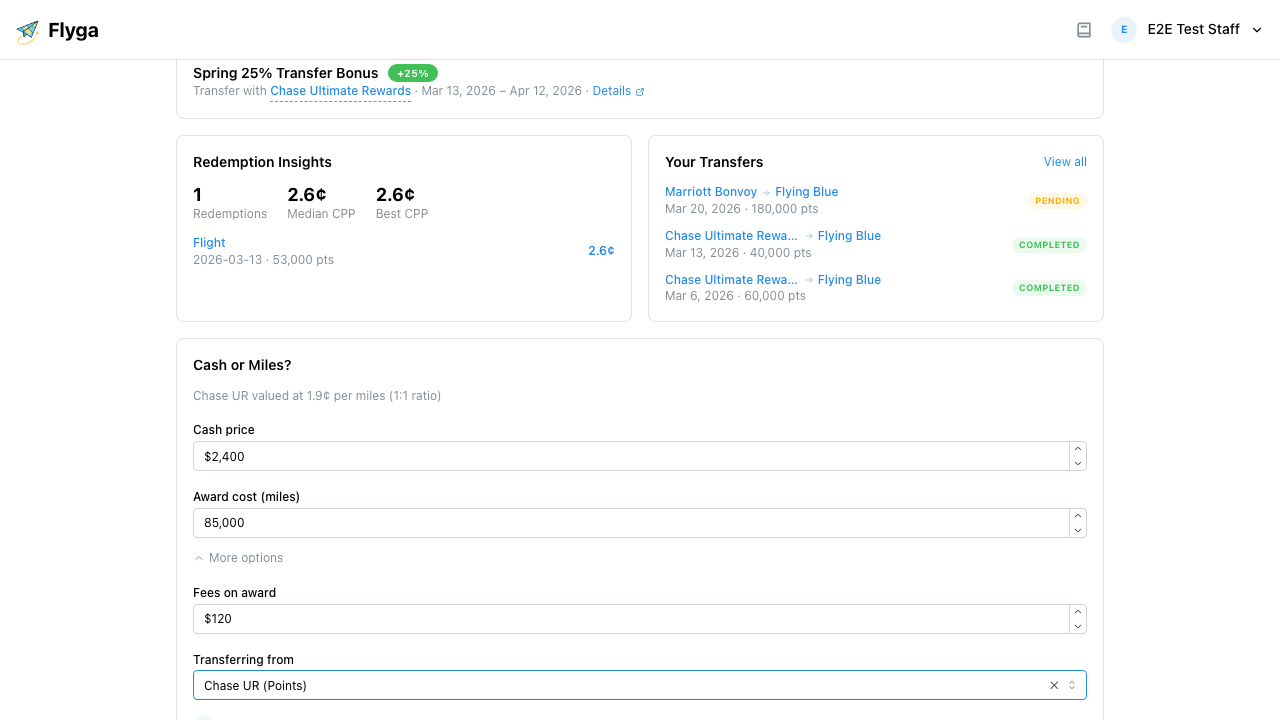
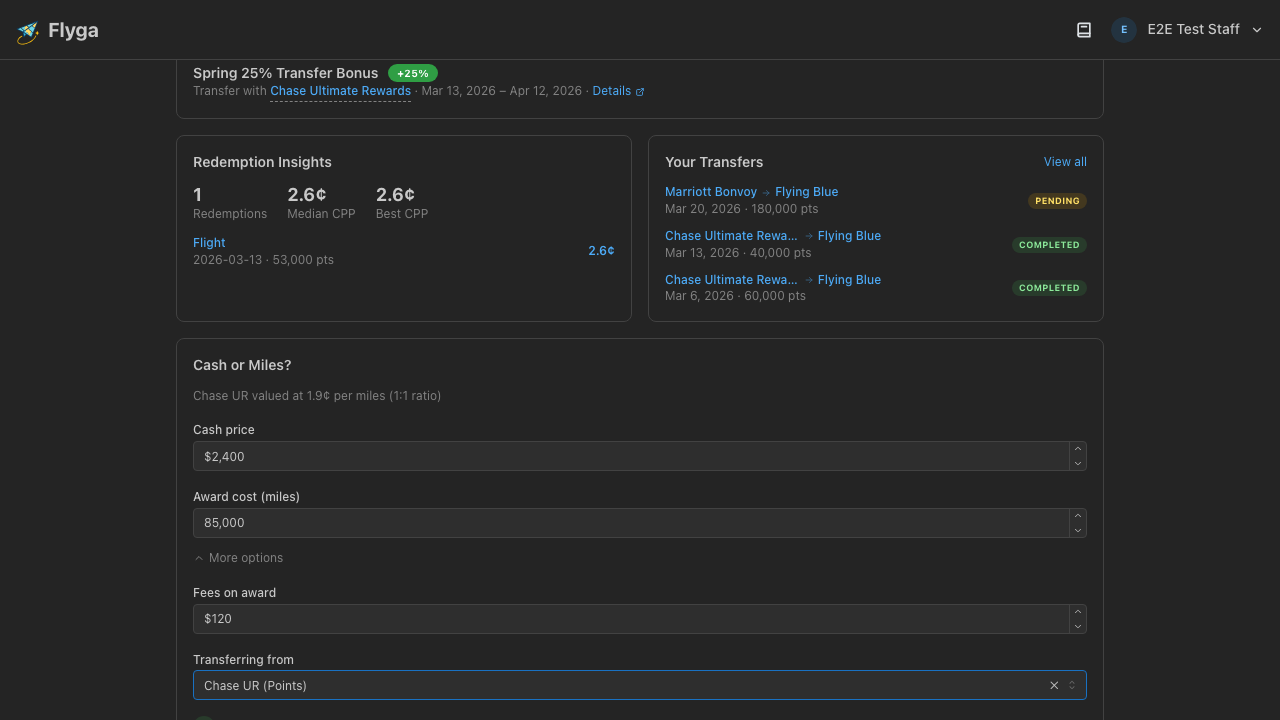
When a transfer partner is selected, the valuation line at the top updates to show the effective cost. For example, if you’re transferring Bilt points (1.8 cents) at a 1:1 ratio into an airline program, the calculator values each destination point at 1.8 cents — because that’s what you’re giving up.
Example Walkthrough
Section titled “Example Walkthrough”Say you’re looking at a business class flight:
- Cash price: $2,400
- Award cost: 85,000 miles
- Fees on award: $120
Without fees: $2,400 ÷ 85,000 = 2.8 cents per point. With fees factored in: ($2,400 − $120) ÷ 85,000 = 2.7 cents per point.
If the program’s baseline valuation is 1.5 cents, this is a great redemption — nearly double the average value.
Now add a transfer partner. If you’re transferring from Chase Ultimate Rewards (valued at 1.8 cents) at 1:1, the effective cost of those 85,000 miles is 85,000 × 1.8 cents = $1,530 in value. That’s still less than the $2,400 cash price, but the margin is tighter. The calculator shows you this instantly so you can make an informed decision.
When to Use It
Section titled “When to Use It”- Before booking an award — Sanity-check whether points or cash is the better deal
- Comparing transfer partners — If multiple programs can get you to the same airline, try each one to see which transfer path costs you the least in point value
- Deciding whether to transfer — If the CPP is below baseline, you might want to save your points for a higher-value redemption later